- Salice Thomas
- Follow Me
- January 18, 2025
-
Introduction
Information systems have become key assets of all sectors of business activity. Through extensive and continuous use over the years, these systems become potential source of important knowledge and information about the various processes of business as acquired by the respective organizations throughout their life time. Some of these systems though running on legacy hardware and software would be working so satisfactorily that the owner would not prefer to replace it. Some would also require a 100% availability and so cannot be taken off from service. Technology changes are but happening at a rapid phase and adopting the novice becomes crucial for ensuring the credibility and value of the business. These aspects get the organisations to make a choice on dismantling older systems and completely replacing them, or incrementally modernize existing systems. Many businesses choose the latter course, seeking to minimize their existing investment and preserve valuable business knowledge, while adapting to rapidly evolving technologies. Maintaining and upgrading such legacy systems is one of the most challenging and critical issues faced by most of the enterprises. These systems are hard to be maintained, improved and expanded because mostly there will be a lack of understanding about the system due to improper documentation and at times even the operation staffs of the system, before it was termed a `Legacy`, would not be continuing in the organisation. Here we describe on the basic processes that can be adopted for successfully modernizing a legacy system and some key processes that adds to improving the performance of the legacy systems
A Glimpse into the Usage of legacy systems
The term “legacy system”, was informally defined by Bennett as “large software systems that we don’t know how to cope with but that are vital to our organisation. Legacy systems are very old computer systems, usually between 15 and 25 years old, though some may be as old as 40. This include computer applications, both hardware and software that are integrated and running on millions of lines of code. These systems are build by making huge investments and over the time they become center of many business operations and at times even work round the clock to supporting unique business processes. Most of these systems are in use for such a long period of time that they would have outlived their original user requirements. Constant technological change often weakens the business value of legacy systems, which have been developed over the years through huge investments. Some of the examples for legacy systems evolution are
1. Extension: Adding some functionality or feature relating to changes in regulations or some emerging business needs, or new features made available by the competition.
2. Migration: Migrate the legacy system to a new platform, preserving much of the existing software.
3. Cosmetic makeover
4. Redevelopment of modules, hardware etc.
5. All of the above
It is estimated that about 80% of IT systems are running on legacy platforms. The NASA`s space shuttles still uses the 1970s technology, considering the replacement time and cost. International Data Corp. estimates that 200 billion lines of legacy code are still in use today on more than 10,000 large mainframe sites.
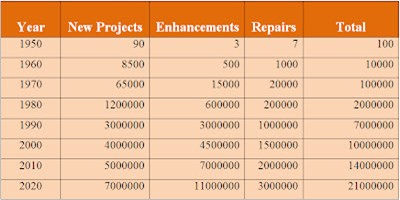
The table above shows the extrapolations for the number of programmers working on new projects, enhancements and repairs. In the current decade, four out of every seven programmers are working on enhancement and repair projects. The forecasts predict that by 2020 only one third of all programmers will be working on projects involving construction of new software.